Friday, September 26, 2025
Global Sourcing 2025–2026: Procurement between digitalisation, risks and new rules

Source: shutterstock.com/ESB Professional
The world of purchasing is characterised by almost daily surprises, constant change and ever-new challenges. Trade conflicts, geopolitical tensions and new regulatory requirements are forcing companies to constantly adjust or realign their purchasing strategies. The focus is on procurement, which today must do more than just optimise costs or ensure quality parameters: resilience, sustainability and digital transparency are becoming equally important success factors.
Digitalisation as an opportunity and a burden
Digital tools enable real-time monitoring of supply chains, AI-supported forecasts and improved risk analyses. However, the European Commission warns that the digital transformation in the EU is progressing more slowly than necessary. For purchasing departments, this means that investments in IT systems and data interfaces are inevitable – at the same time, requirements for data protection and integration capabilities are increasing.
Supply chains under pressure
But BME companies also recognise that supply chain risks remain a key factor. The Ifo Institute reports that around 58% of German manufacturers have already diversified their procurement base. Multi-sourcing, nearshoring and strategic warehousing are becoming increasingly important in order to reduce dependence on individual regions or suppliers. This is also reflected in the BME studies.
In one of BME’s surveys, the top three purchasing measures were the expansion of alternative supply chains, the intensification of supply chain digitalisation and the relocation of sourcing markets.
Global trade flows are shifting
Data from the Federal Statistical Office show that import and export volumes are increasingly shifting, especially in relation to China and the USA. For purchasing, this means taking country-specific risks more strongly into account in calculations and keeping an eye on legal requirements. But it also means knowing and recognising the opportunities and possibilities offered by different markets. The BME actively supports German companies in meeting this challenge. In 2025 alone, the BME organised five purchasing initiatives on behalf of the Federal Ministry for Economic Affairs and Energy (BMWE) in cooperation with the German Chambers of Commerce Abroad (AHK). The Western Balkans, India, Southeast Asia, the Baltic States and Finland, as well as the Maghreb – together with other activities such as the BME's Procurement & Supply Forums and sourcing tours, the focus was on over 25 countries. "My team and the BME have organised over 1,000 B2B meetings for well over 100 purchasing organisations this year," says Olaf Holzgrefe, Head of International at the BME. “Strengthening the European supply chain, supply chain diversification or expanding multiple sourcing – the intentions vary. But we recognise that local for local still offers potential in Europe,
especially in Eastern Europe."
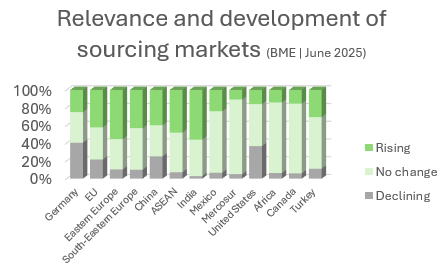
The figures from the BME survey conducted in June speak for themselves.
Eastern Europe is at the forefront in terms of relevance. But South-Eastern Europe, India, ASEAN and China are also in the focus of purchasers for the coming years, showing that procurement needs to take a broad view.
"We will continue to address the procurement markets for the BME community and purchasing in 2026," Olaf Holzgrefe continues. "But in addition to traditional matchmaking, we are also expanding our 'Sourcing Spotlights' in order to sharpen market knowledge and provide a better overview."
Both: the events related to B2B matchmaking and the free market information webinars can be found on the BME's B2B platform: www.bmematchmaking.com.
Challenge of SMEs and sustainability as a mandatory program
BME's activities are aimed at the German economy. Whether it is supplier scouting, global sourcing or other purchasing issues, small and medium-sized enterprises need support. This is also evident in the IT sector. While large corporations can usually rely on their own IT platforms, broad supplier networks and capital reserves, small and medium-sized enterprises (SMEs) struggle with limited resources. They often lack data standards, market power and scope for investment in digitalisation or diversification. Strategic cooperation – for example in the form of purchasing groups – and modular IT solutions are considered practical ways to ensure competitiveness. At the same time, demands are increasing with varying regulations. Whether it's EU requirements for CO₂ accounting or the Supply Chain Act, the complexity for purchasing and companies in terms of transparency and compliance is growing. Mastering this is an art.
For more information on the BME's purchasing initiatives, sourcing events or free sourcing and market webinars, please visit: www.bmematchmaking.com.
Global Sourcing 2025–2026: Procurement between digitalisation, risks and new rules
The world of purchasing is characterised by almost daily surprises, constant change and ever-new challenges. Trade conflicts, geopolitical tensions and new regulatory requirements are forcing companies to constantly adjust or realign their purchasing strategies. The focus is on procurement, which today must do more than just optimise costs or ensure quality parameters: resilience, sustainability and digital transparency are becoming equally important success factors.
Digitalisation as an opportunity and a burden
Digital tools enable real-time monitoring of supply chains, AI-supported forecasts and improved risk analyses. However, the European Commission warns that the digital transformation in the EU is progressing more slowly than necessary. For purchasing departments, this means that investments in IT systems and data interfaces are inevitable – at the same time, requirements for data protection and integration capabilities are increasing.
Supply chains under pressure
But BME companies also recognise that supply chain risks remain a key factor. The Ifo Institute reports that around 58% of German manufacturers have already diversified their procurement base. Multi-sourcing, nearshoring and strategic warehousing are becoming increasingly important in order to reduce dependence on individual regions or suppliers. This is also reflected in the BME studies.
In one of BME’s surveys, the top three purchasing measures were the expansion of alternative supply chains, the intensification of supply chain digitalisation and the relocation of sourcing markets.
Global trade flows are shifting
Data from the Federal Statistical Office show that import and export volumes are increasingly shifting, especially in relation to China and the USA. For purchasing, this means taking country-specific risks more strongly into account in calculations and keeping an eye on legal requirements. But it also means knowing and recognising the opportunities and possibilities offered by different markets. The BME actively supports German companies in meeting this challenge. In 2025 alone, the BME organised five purchasing initiatives on behalf of the Federal Ministry for Economic Affairs and Energy (BMWE) in cooperation with the German Chambers of Commerce Abroad (AHK). The Western Balkans, India, Southeast Asia, the Baltic States and Finland, as well as the Maghreb – together with other activities such as the BME's Procurement & Supply Forums and sourcing tours, the focus was on over 25 countries. "My team and the BME have organised over 1,000 B2B meetings for well over 100 purchasing organisations this year," says Olaf Holzgrefe, Head of International at the BME. “Strengthening the European supply chain, supply chain diversification or expanding multiple sourcing – the intentions vary. But we recognise that local for local still offers potential in Europe,
especially in Eastern Europe."
The figures from the BME survey conducted in June speak for themselves.
Eastern Europe is at the forefront in terms of relevance. But South-Eastern Europe, India, ASEAN and China are also in the focus of purchasers for the coming years, showing that procurement needs to take a broad view.
"We will continue to address the procurement markets for the BME community and purchasing in 2026," Olaf Holzgrefe continues. "But in addition to traditional matchmaking, we are also expanding our 'Sourcing Spotlights' in order to sharpen market knowledge and provide a better overview."
Both: the events related to B2B matchmaking and the free market information webinars can be found on the BME's B2B platform: www.bmematchmaking.com.
Challenge of SMEs and sustainability as a mandatory program
BME's activities are aimed at the German economy. Whether it is supplier scouting, global sourcing or other purchasing issues, small and medium-sized enterprises need support. This is also evident in the IT sector. While large corporations can usually rely on their own IT platforms, broad supplier networks and capital reserves, small and medium-sized enterprises (SMEs) struggle with limited resources. They often lack data standards, market power and scope for investment in digitalisation or diversification. Strategic cooperation – for example in the form of purchasing groups – and modular IT solutions are considered practical ways to ensure competitiveness. At the same time, demands are increasing with varying regulations. Whether it's EU requirements for CO₂ accounting or the Supply Chain Act, the complexity for purchasing and companies in terms of transparency and compliance is growing. Mastering this is an art.
For more information on the BME's purchasing initiatives, sourcing events or free sourcing and market webinars, please visit: www.bmematchmaking.com.